Accessibility
Linguistic accessibility services
Dotwords provides linguistic accessibility services to companies and institutions that want to become truly inclusive, for people with sensory disabilities, deaf and blind people, and linguistic minorities.
Accessibility
Linguistic accessibility services
Dotwords provides linguistic accessibility services to companies and institutions that want to become truly inclusive, for people with sensory disabilities, deaf and blind people, and linguistic minorities.
We have directed our expertise towards inclusivity
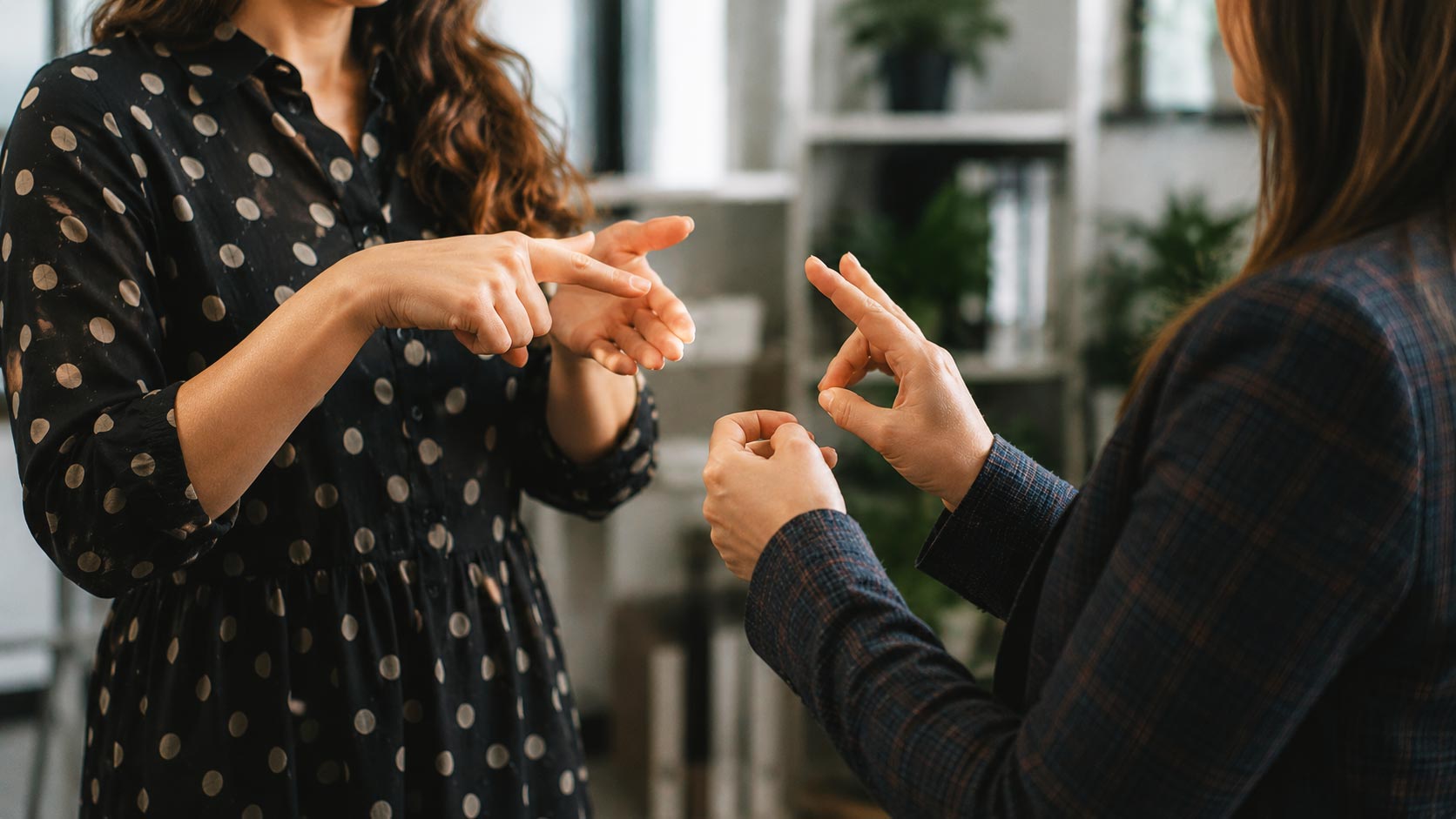
With texts and videos adapted to different tools: translations, subtitles, Italian sign language (LIS) and audio descriptions for blind people.
We are able to communicate effectively and ensure that important messages reach everyone, combating discrimination while also promoting socially beneficial activities.
How we support people who are deaf or hard of hearing and people who are blind or have low vision
Subtitling for people who are deaf or hard of hearing
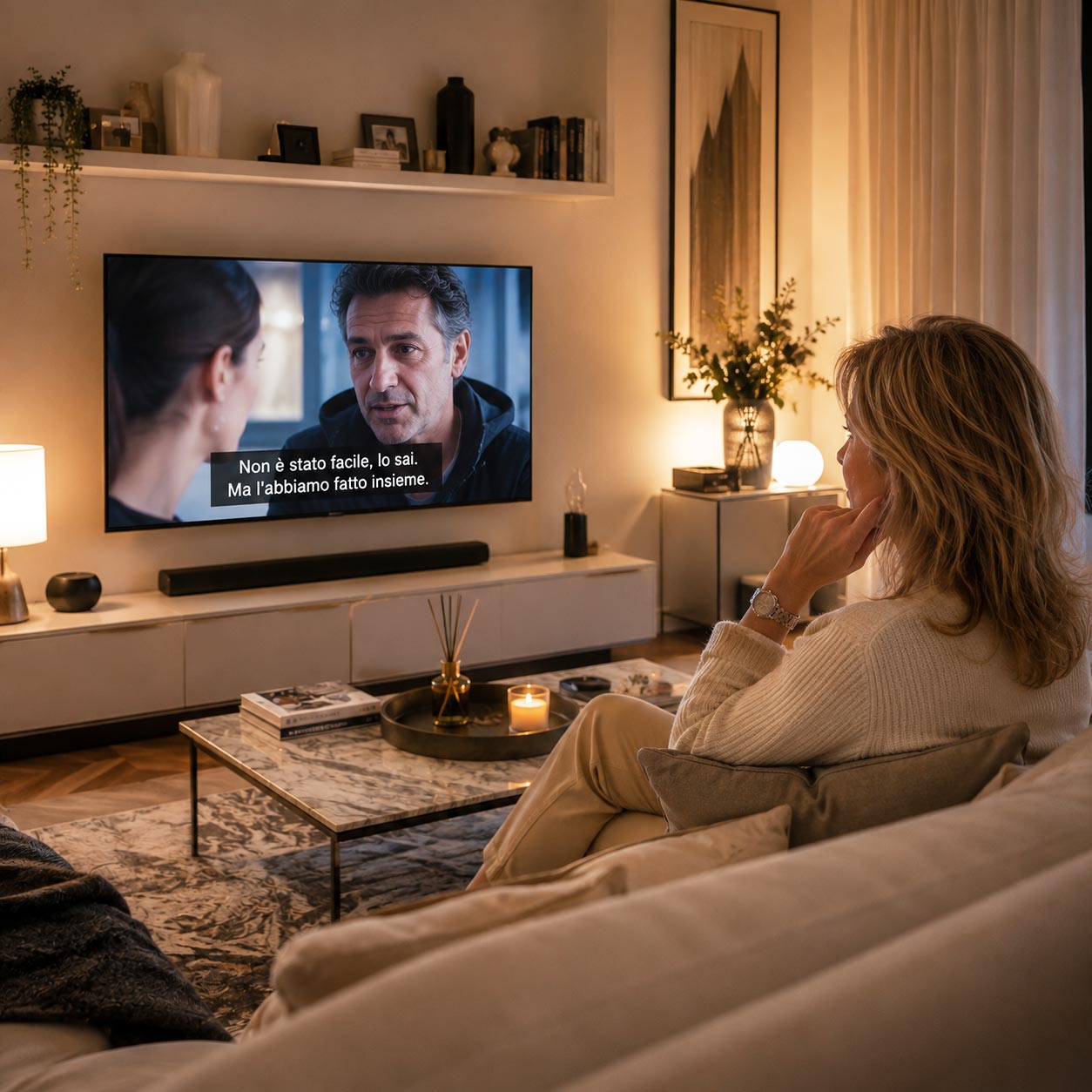
Subtitling for people who are deaf or hard of hearing involves a methodology comprising techniques and protocols that transform a video with audio into a format that is accessible to deaf and hard-of-hearing audiences.
Subtitling for people who are deaf or hard of hearing aims to convey not only the language that is strictly verbal, but also body expressions and sounds occurring in the scene: just think of moments featuring a moving train or someone joyfully jumping into a puddle.
Subtitling for people who are deaf or hard of hearing makes the message more immediate without altering its content, while taking into account the linguistic register and emotional nuances. To achieve this, we rely on conventions also recognised by the deaf and hard-of-hearing community: for example, a specific colour is assigned to the subtitles of a particular character, while sound effects are indicated through text highlighting.
Intralingual subtitling for deaf and hard-of-hearing audiences must also take reading speed into account: some deaf viewers may read more slowly and may find it more difficult to process long texts or text spread across several lines. Single-line subtitles are therefore preferred, or two lines at most when the sentence is clearly segmented.
To create high-quality subtitles for deaf and hard-of-hearing audiences, it is necessary to follow specific standards and editorial conventions concerning subtitle length, positioning, colour, on-screen duration and font.
It is also necessary to be able to condense, simplify and clarify the original message, without altering its meaning or register, while making appropriate adjustments to punctuation.
Providing a professional video subtitling service designed to ensure accessibility for the deaf and hard-of-hearing community therefore requires more than a good knowledge of written and spoken language. It also requires specialised training in audiovisual translation and subtitling, as well as solid experience in the field and ongoing collaboration with LIS interpreters, the sign language professionals who understand the needs of the target audience.
Dotwords provides accessible subtitling services and has the technological tools required to create, edit, synchronise and format subtitles according to the characteristics of the video and the client’s requirements.
Audio description for people who are blind or have low vision
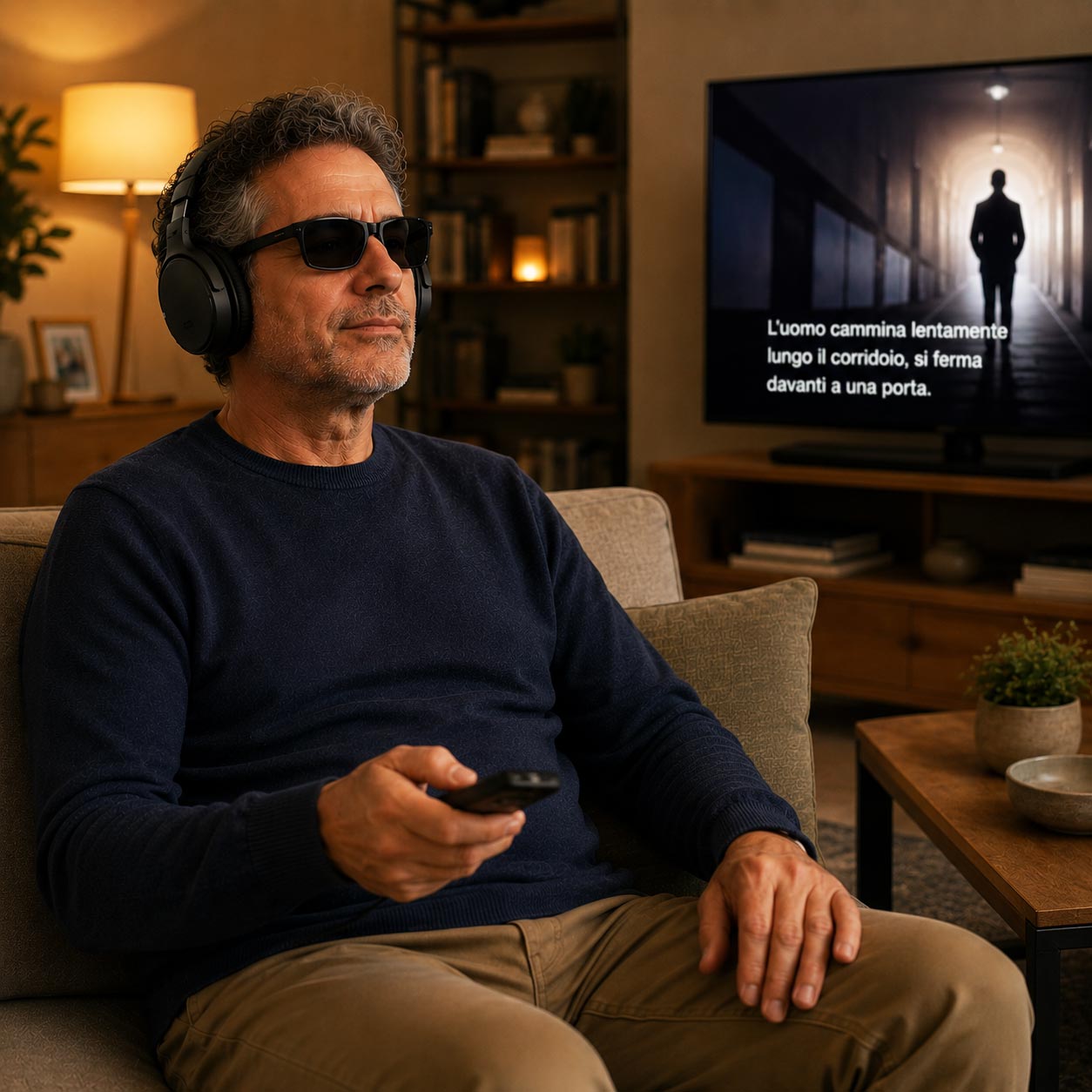
Audio description for people who are blind or have low vision is a service that enables people who are blind and people with low vision to enjoy content originally created for the wider public. It makes TV programmes, films, sporting events, theatre performances and more accessible.
Audio description for people who are blind or have low vision consists of recording an additional audio track that is added to the original and used to describe anything that cannot be perceived visually by a person who is blind or has low vision. Elements such as costumes, landscapes, facial expressions and interactions are carefully described to provide a detailed picture of what is happening.
The additional audio is inserted naturally during pauses in the main audio track. Creating an audio description for people who are blind or have low vision is a highly specialised skill involving several stages: preparing a script by professional audio describers, recording it with one or more narrators, and carrying out the final mixing and integration with the original audio.
Protecting linguistic minorities
A community’s identity is shaped by various elements, one of the most important being language. Through language, a community expresses its culture: stories, fairy tales, religious rituals, and traditions. Everything is embedded in language. If a language disappears, the cultural identity of its community is also at risk of disappearing.
This is why it is essential to protect linguistic minorities. Without the language and the community that passes it down, its knowledge can also be lost, leaving the world poorer.
In this sense, translation helps by building bridges and creating connections between different cultures. By translating, we help communities integrate through the localisation of bureaucratic documents, healthcare information, civic regulations and more.
This is an example of how translations can help protect and give greater visibility to linguistic minorities.
Our Commitment
With its expertise, Dotwords supports initiatives such as subtitling personal development courses for people who are deaf or hard of hearing: an activity that has also attracted the attention of the leadership of the National Deaf Association of Italy (ENS) in Lombardy. We also provide multilingual translation and localisation services for the texts of D.i.Re (Women in Network Against Violence).
We also support projects that are close to our hearts, such as those run by the non-profit organisation Handicap…su la testa! Our staff provides volunteer services for the organisation.
Our accessibility services are designed for people who are deaf or hard of hearing, people who are blind or have low vision, linguistic minorities, and people with sensory disabilities.
Do you need accessibility services?
Get in touch: we’ll be happy to provide you with a no-obligation quote.